Thursday, 2 March 2023

Magic items - part 2

Reposting from my ancient bloggage! 


Continuing from part 1, I'm going to look at what we can do to make magic items more awesome and interesting.

But first, I need to talk about consumables and artefacts - because magic items aren't always infinite, permanent things, and that is a significant difference.

Consumables versus artefacts
Consumable magic items of one sort or another are a near-ubiquitous trope in fantasy fiction: various powders, foodstuffs, liquors and salves that are used up each time they are applied, and grant special effect to the consumer - they allow the hero or villain a one-time chance to magically cheat.
In part 1, I mentioned d'Artagnan's cure-all salve, but let's also consider literally consumable magic items - fantastic foods like Lord of the Rings' lembas elvish way bread, and Thomas Covenant's aliantha treasure-berries; or potions like Getafix's strength potion, and Oberon's love potion.

(Incidentally, after some digging around, it appears that the now common idea of one-shot magical scrolls first appears with Vancian magic (from Jack Vance's Dying Earth, later stolen paid loving tribute in D&D). Magical writing prior to that appears to be thought of as permanent - which makes sense, really, given that this is what writing is for: permanence.)

Anyway, back to the topic: the drama of consumable magic items is that they run out. The hero cannot always be saved - and in some instances, reaching the precious item becomes a point of tension itself. Remember Popeye straining to get to his last can of spinach?

Items that are used up are in effect sacrificed. The magic is called up by the destruction of the precious thing (even if it is only precious because of the magic it will invoke - let's not get bogged down in circular argument, though). Token objects have been found at temples sites by archaeologists - sacrificial items to invoke magic. So we have a long tradition of one-shot magic, where the magical item is exhausted in the act.

Compared with items that never run out, this is a significant difference of drama and narrative in itself. If Excalibur only worked once, the whole story would be radically different.

So let's draw a line between one-shot and permanent magic items.

What to do about it?
In part 1, I hope I made it fairly clear that I think magic items should not be the common tools that they have become in our hobby - and in this part, I hope also that I've shown there is a distinction between two broad types of magic items: the one-shot consumable, and the persistently magical artefact.

Here, then, is my core aim: 
Magic items should START awesome, and STAY RARE.

By which I mean that the tool box of mundanely magic items should all but go - no more stacks of trinkets providing small bonuses here and there - leaving only the powerful and exciting magic items. So the first time a permanent magic items shows up in the game, it should be an awesome item. There should be no lesser items in the game.
These powerful items should remain rare, so that the discovery of each one is a memorable event.

The tool box need not completely vanish of course - that's why I pre-ambled for so long about consumable items. Consumable items can replace the myriad mundanely magical trinkets (look: alliteration - literary!) - potions, oils, paper bombs and other one-shot items can make up an adventurer's utility belt.

But permanent magic items should never be reduced to tools.

How we can actually enforce such a concept on our games will depend on the rules we're working in, of course. We can use increased thresholds for crafting magic items, changed probabilities on  random treasure tables, and the like.
I have in mind (for example) the idea that the special materials in the d20 OGL rules should become cheaper - these are materials that grant special properties to things made from them, but are not inherently magical. The special properties are impressive (adamantine cuts through most objects, for example), but are not magical.
However, as the rules currently stand, these special materials are so expensive that it is cheaper to make an item magical than it is to make it out of one of the special materials.

As for permanent magic items, some maths modelling is probably needed to work out an optimal way to encourage awesome item creation (again, depending on the game system you use)  - but the GM can simply veto dull items (the kind that grant +2 to this, +1 to that) when creating treasure, replacing such things with single-use of limited charged items.

What is awesome?
Your mileage may vary, so to speak, but generally a clear and overt spell effect is awesome, whereas a numerical bonus is a little dull. A flaming sword, arrow-repelling armour, a ring of water walking, or an invisibility cloak - these clearly awesome.

This is not to say that improving abilities can't be awesome. In old editions of D&D there were magical items that literally doubled your character's weapon damage, for example. A massive bonus like this is certainly in the realms of awesomeness. What we should be avoiding is a +2 or +4 here and there, and favouring a +8 or +10 instead.

In short, awesome magic items allow the user to do something they could not normally do - not by improving their abilities, but by giving them new ones.

What is rare?
I'm thinking that any character should only have one or two permanent magic items, plus a plethora of one-shot tools, at the peak of their career.
These permanent items should be signature items that are as famous as the hero or villain wielding them. The tool belt of one-shot items can be pretty cool in their own right, but they shouldn't be things that the character relies on and uses in all encounters.

What does this do to the game?
Permanent magic items become more impressive - both from their rarity, and their (hopefully) inherent awesomeness. Characters may become associated with their awesome artefact - such as Thor's hammer, or Arthur's sword.
Limited magic items become a resource to be managed. Those potions and scrolls won't last forever.

Ultimately, I think adventuring will be more dramatic - without the mundane magical shopping trip, the golf-bag of enchanted swords, the bag of holding with half the Gamesmasters' Guide treasure list stashed away in it.
Heroes will have to rely on their own skills and abilities more, with only one or two signature magical items.
Villains will wield significant artefacts that can be the target of the heroes' plan (steal the Evil High Priest's Staff of Horrors, and he's nothing but a mortal man).

How to mechanically achieve this balance of magic items will depend on the game you're playing - I still have plenty of work to do to make magic item tables for my own game. When I'm done, I may post another article showing the workings - but don't hold your breath....

There's no reason why we can't just wing it - it's a lot less work! But ultimately, to show fairness in action, it helps to enshrine those principles in the rules.
Of course, like many things in RPGs, it is often far easier to think of a general principle and aim, and use GM judgement to apply that principle, than it is to make rules to reflect it.

Magic Items - part 1

Here's another old post from my previous bloggage!

Players love their magic items. I've been converting the magical equipment and weapons that a D&D party gained over the course of their career, into similar items for the game I'll be running - and it got me thinking about the topic in general terms.

This is a big topic! I started writing what I thought would be a short post about magic items and my concerns with the darned things - and found that I need to do this in two parts.
In this part, I'll ask what are "magic items", what role do they serve, and why do most fantasy games seem to fail at delivering the exciting and amazing magical things that fable and literature abound with?
In part two, I'll  stop complaining and talk about what might be done to solve the issue.

What are magic items?
Magic items are just that: items of some sort that have some magical property. The One Ring from Lord of the Rings, the Sivalinga in Indiana Jones and the Temple of Doom, the flying carpet in Arabian Nights - as well as lesser tools, such as the magical trickery of skiving lunch boxes in Harry Potter, or d'Artagnan's healing salve in The Three Musketeers - are all magic items.
In literature and myth, magical equipment, weapons, armour and jewellery are special things, maybe even central to the plot.
In RPGs, magic items tend to be routine - and that is what has been bugging me.

What's wrong with the way that RPGs deal with magic items?
For a start, the name isn't great."Magic items" is a deliberately bland term - making dull broth out of awesome sauce.
By being generic, they become a standard issue bit of equipment, losing that magical quality like a folding shovel: "You don't have a Bag of Holding? You call yourself an adventurer!"

Why is this a problem? A proliferation of magic items in your game makes it hard to use a magic item as a McGuffin - players are not interested unless the item is very powerful, and then unless you explain the dread significance of the One Ring, tend to be only covetously interested.
(Even knowing the "drawbacks" of the One Ring, many players would tend to think that being the Dark Lord of Middle Earth would be awesome, thank you very much. Clearly, that's not the drama that the Professor intended when he wrote Lord of the Rings.)

Also, we tend to end up with uninterested players if there are too many magic items in a game. I recall a joke in one player group about high level characters having golf caddies to carry their magic swords around for them. "Another magic sword? Yawn.... Put it with the others."

History of RPG items
It's worth looking at how the gaming industry has developed this modern relationship with magic items in the RPGs.
In early RPGs, magic items tended to be relatively rare - or at least the intent of the game-writers was that they should be relatively rare. Let's look at the chances of finding magic items in an early edition of D&D, and in a later edition.

In the Basic D&D, the chance of finding any magic item at all in a treasure horde is about 27.5% (there are ten treasure types, each with a variable percentage chance of having one or more magic items).
These chances remain fixed throughout the game, at all levels of play - however, at low level, the monsters you face tend to be the ones without magic items, whereas at high level the tend to be ones with more.

In 3.5 Edition D&D, the chance of a treasure containing magical items increases with level:

  • Low level: 5% to 50%
  • Mid level: 50% to 90%
  • High level: 75% (varies)

Strangely enough, the chance of a magic item being present in a treasure at high levels actually drops to around 75% or so (with some aberrations in the treasure table - 19th level, for example), but the power of those items is generally increased.

It's not a big increase to be honest - can it be responsible for the plethora of magic items in modern RPGs?
I doubt it.

Shopping is not heroic
Aside from the slightly increased frequency of finding magic items as part of a treasure, there is another significant change that has appeared since the early RPGs: the magic item market.
In the first D&D rules sets, magic items were listed in the Dungeon Masters Guide - that is, away from the players. There were no prices listed for magic items, either - the rules merely hinted that some non-player character might be found through advertising, and persuaded to buy unwanted magic items. Costs could be derived from the section about creating magic items - and even the least potion would be an investment of thousands of gold pieces.
Jump forward to the 21st Century, and in D&D 3.5 we've got magic items starting with values of 25 gold pieces, and a listed price for each, together with rules for how many magic items (based on cost) one is supposed to have at any given stage in one career.

So our heroes go shopping for magic items. There are so many trivial little magic trinkets to choose from too - stacking up all those tiny little bonuses to optimise your "hero"...

Now, I'm having great fun with Bethesda's Skyrim still - I tend to play games like this over and over - but I find that as much as I enjoy the adventure game, I get so annoyed with the damn shopping. I have trading fatigue. A hero's life shouldn't be bogged down with running around between traders haggling, or making potions to make her better at haggling. This is all stuff that won't make it into the epic tale of the Dragonborn when the bards tell it, right?
It's because there are so many tiny little footling bonuses that you desperately want to stack together - "Must buy more magic thingies!"

Did Frodo and Co go shopping in Rivendell? Did Conan spend all his money on necklaces of natural armour and belts of giant strength?
No, they went boozing and blew their loot on whores, and sang songs with the elves and ate big feasts.
(You can figure out which did which.)

Next: I solve everything
We know what's wrong (or what I think is wrong) - too many trinkets, not enough excitement, and far too much shopping - so what am I going to do about it?
See the next part, coming soon!

Wednesday, 11 January 2023

The Wisdom of Elders

 Years ago, I was trying to write an essay of helpful stuff about RPGs, when I found that as I did my research, I wasn't really able to better anything that had been said before by the essayists I respect.

So here are a few links to blog posts and essays by others on RPGs that I've found influential over the years. All credit to the authors of the originals!
Tucker's Kobolds
An essay by Roger E Moore on making encounters difficult - and fun.

Many high-level characters have little to do because they're not challenged. They yawn at tarrasques and must be forcibly kept awake when a lich appears. The DMs involved don't know what to do, so they stop dealing with the problem and the characters go into Character Limbo. Getting to high level is hard, but doing anything once you get there is worse. ...

Don't Prep Plots
An essay on RPG story design by Justin Alexander
If you're GMing a roleplaying game, you should never prep a plot.
Everyone's tastes are different. These matters are subjective. What works for one person won't necessarily work for another. Yada, yada, yada.
But, seriously, don't prep plots. ...

On the same topic: Justin Alexander's essays on Node-based adventure design can be found here.

Getting the players to care
Another essay by Justin Alexander

I think every GM probably has a story about the time that they spent hours carefully detailing some piece of lore or a particularly intricate conspiracy... only to discover that their players didn't really care. Or you complete a dramatic and powerful series of adventures featuring the unraveling of a conspiracy wrought by the Dark Gods of Keht... but three months later you mention the name "Keht" and are met by blank stares from the players...

The Wizard says: "This is a republished post from my previous blog - enjoy!"

Saturday, 7 January 2023

Dungeon23 week 1

Continuing the dungeon23 plan, I've been laying out the districts and filling in some details for the city of Katravia.

I'm considering each layer of detail to count as one room - so the top layer "There is a city called Katravia" and its short description was what I covered in the first post, on Day 1, and over this first week, I've been digging down into more detail...

My next "room" is the next level of detail - the city of Katravia is made up of these districts:

Katravia's Districts

I've got slightly more districts than 1 per month, but that'll be fine - some of these will get merged into just a few "rooms".

To help keep my ideas organised, I made a generic template for locations, years ago - I'll be using that for Katravia.


Now the next set of "rooms" are at this layer of detail - for each of the districts on the overview, I'll be making a Location Brief, and drawing up a few ideas for buildings and other locations, with an area map to show how they relate.


Once I have all the districts briefed, I'll be moving on to those buildings - or if something grabs my attention on the day, I'll get straight into it! Like I did with the Theatre map in the Entertainers' Quarter for example.

I'm also aiming to keep the one-location-per-day ration as a guideline, but not necessarily follow it perfectly - I'll aim for a buffer of a few extra locations each month to allow myself to have off days!

All in all, I'm pleased with the initial progress - it's not going to be a publishable setting guide, but it's the sort of thing I can happily use for myself.

Meanwhile, I'll be updating and re-publishing some old RPG blog posts, and posting any other RPG thoughts and reviews that come to mind - so that this doesn't just become the Katravia blog!

Sunday, 1 January 2023

Prompted by the Guvnor at the Tavern, today, I'm starting Dungeon23!


A 365-room mega dungeon is the general idea - but I decided that the utility of the mega dungeon is too limited for me to invest all that time in. 

Instead, I'm going to do a city. With a city, I can cover points of interest and adventure, have lots of variety, have locations that are legitimately unconnected - whatever I'm feeling like on the day. Also, the districts and buildings I come up with should be useful to drag'n'drop into other games - which is always a bonus.

The city I'll be creating is Katravia, from a Pathfinder shared world I was GMing in a couple of years ago - I've got some basic layout and themes already drafted, so that'll be the framework for the project.

The format suggested is in a journal, so I'll be working on paper, and posting photos of the work, with comments. And rather than spamming this blog daily with updates, I'll collate things weekly.

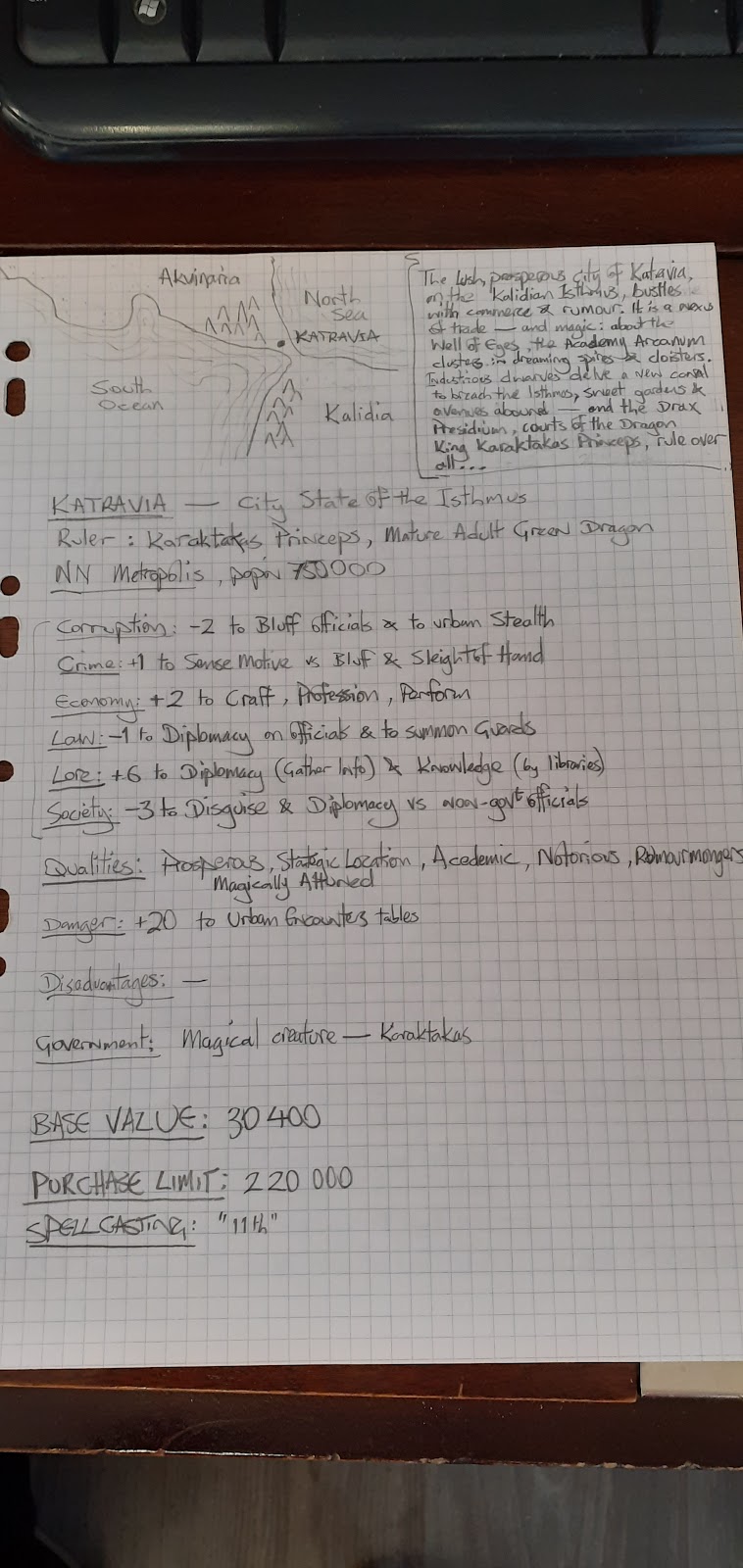
Katravia outline


Katravia, City State of the Isthmus

The lush and properous city of Katravia in the Kalidian Isthmus bustles with commerce and rumour. It is a nexus of trade - and magic! Around the Well of Eyes, the Academy Arcanum clusters in dreaming spires and cloisters; industrious dwarves delve a new canal to breach the Isthmus; sweet gardens and avenues abound - and the Drax Presidium, the Courts of the Dragon King, Karaktakas Princeps, rule over all...

I've used the Pathfinder Gamesmastery Guide format for settlements to establish things like prosperity, crime rate, and other qualities - but it's my intent to keep things system agnostic, so those numbers from my old draft will need some explanation!

  • "NN Metropolis": Katravia is a truly neutral place in terms of moral and philosophical outlook. Individuals of course have their own agendas, but collectively, there's only the market forces of trade and reaching for prosperity to guide.
  • Corruption: The officials of the city are on the whole well paid, and slightly less easily bribed
  • Crime: Petty crime is common-place
  • Economy: Katravia is rich, so folk will pay well for your services and goods
  • Law: Officials are slightly more inclined to stick to the rules and ignore appeals, but conversely, the Watch is slightly less primed to respond to calls to alarm
  • Lore: With major academic institutions here, Katravia is a perfect place to do research and gather information
  • Society: Katravians think themselves simply better than outsiders, and this makes them a little stuffy and suspicious
  • Danger: With arcane experiments, fields of powerful magical flux, and a wealth of travellers, the city can be a hazardous place. If your random encounter tables are ordered by challenge, add about 20 % to the rolls to increase the danger.
  • Base value / Purchase limit: Any item costing less than a family home can be readily purchased in the city without much fuss. Only the most rare and power magical items are unavailable to purchase.
  • Spellcasting: There is no practical limit on the spell services one can find in Katravia - only the size of your coin purse.

Red Box Fate - Basics & Bodging

Part of the Red Box Fate series. That was a hell of lot of new rules to add if you're trying to "simplify things", right? Is a...